Previous: “Infrastructure and Public Services”
Note: This article presents the religious environment of Gerasa during the 1st-2nd centuries AD, drawing from multiple decades of the period to illustrate the full scope of religious life in this Decapolis city.
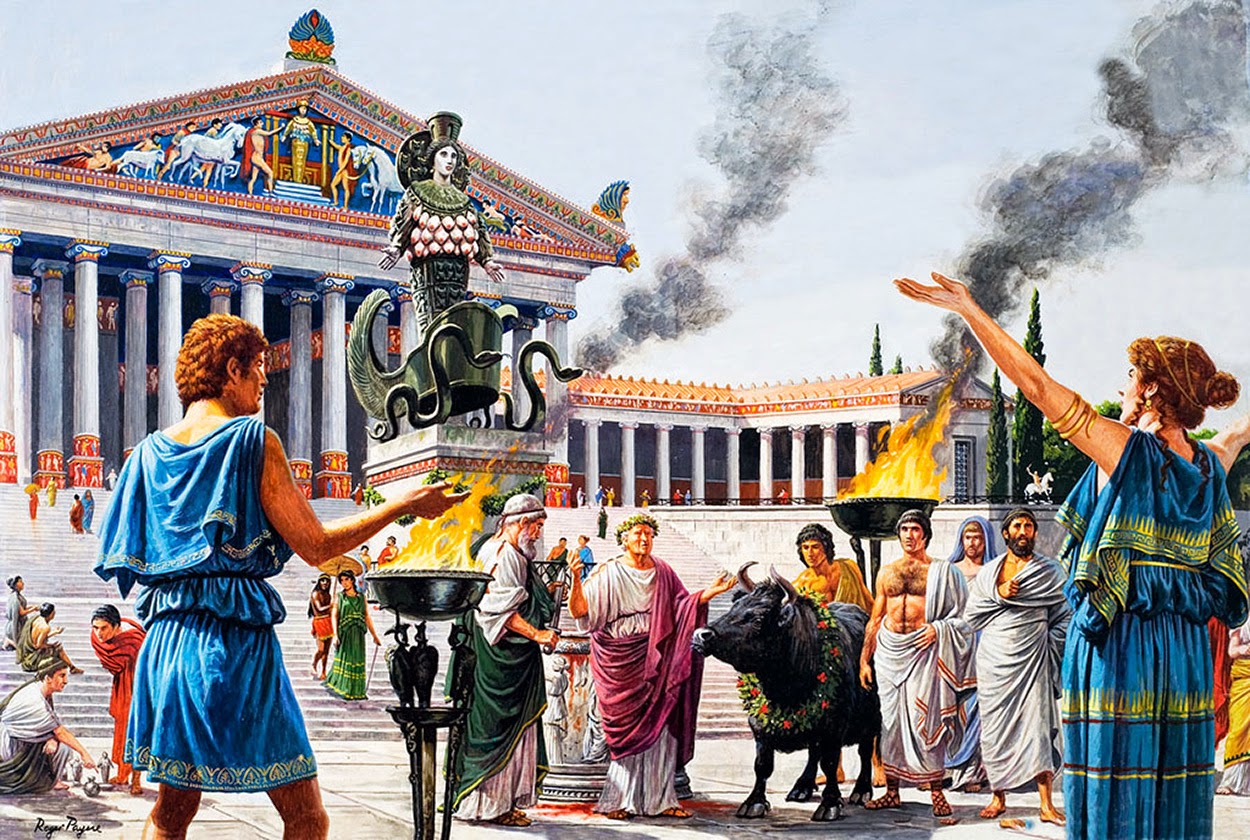
In the bustling streets of ancient Gerasa, the scent of burning incense mingled with the sounds of daily commerce as citizens moved between magnificent temples dedicated to gods both Greek and Roman. The religious landscape of this Decapolis city was a vibrant tapestry of divine worship that reflected both its Hellenistic heritage and its position within the Roman Empire. From the towering Temple of Zeus that dominated the southern hills to the grand processional complex of Artemis, Gerasa’s sacred spaces were among the most impressive in the eastern Mediterranean.
The Divine Hierarchy: Major Deities of Gerasa
Zeus Olympios: King of the Gods
The most prominent deity in Gerasa’s religious pantheon was Zeus Olympios, whose magnificent sanctuary crowned the hill overlooking the famous oval plaza. This sanctuary, with its two-tiered complex, represented the religious heart of the city from the late Hellenistic period through the Roman era. The lower terraced court, measuring approximately 100 by 50 meters, contained the original sacred site with remnants of ancient cultic installations dating back to the late 2nd millennium BC.
The temple itself was a magnificent peripteral octostyle structure on a podium, completed in 162/163 AD, representing the culmination of centuries of religious development at this sacred site. Inscriptions reveal that Démétrios, likely a former priest of Augustus, was one of the major benefactors who contributed to the sanctuary’s construction in the early 1st century AD.
Archaeological evidence reveals the remarkable engineering feat accomplished in the sanctuary’s construction. The complex featured an innovative system of vaulted corridors surrounding the sacred court, with three monumental entrances positioned on the south, north, and east sides. These architectural marvels were the work of Diodôros, son of Zébédos, a local architect whose innovative techniques for constructing intersecting vaults without traditional centering were revolutionary for their time.
-> Discover the architectural innovations that made Zeus’s sanctuary possible in our “Walking Through Ancient Gerasa: A Monument-by-Monument Guide”
Artemis: Patroness of the City
Perhaps even more significant to Gerasa’s identity was Artemis, who served as the city’s patron deity. The Temple of Artemis was considered one of the largest and most important sacred sites in the eastern Roman Empire, covering a massive area that stretched approximately 500 meters from east to west. This monumental complex consisted of five distinct architectural sections: the propylaea east of the cardo with a trapezoid piazza, the propylaea west of the cardo, a forecourt, the inner court (temenos), and the hexastyle peripteral temple standing on a podium.
Inscriptions found throughout the city reveal the various epithets by which Artemis was known: Thea Patroa Artemis, Artemis Kyria, Thea Artemis, Kyria Ourania Artemis, and Thea Laka Epekoa Artemis. Most significantly, on civic coinage, Artemis appeared as “Artemis Tyche Gerason” – “Artemis, the Tyche of the citizens of Gerasa” – a unique identification that made her both the religious patron and the civic protector of the city.
The temple’s construction likely began in the 1st century AD, with epigraphic evidence suggesting the temple probably existed in the second half of the 1st century AD but was completed later in the 2nd century AD. The sacred way (via sacra) terminated in a magnificent piazza, and the propylaea with its three main entrances featured rich elaborate embellishments, all designed along a symmetrical axis that clearly defined the architectural conception of the complex.
Apollo and the Divine Arts
Apollo held an important place in Gerasa’s religious life, as evidenced by several inscriptions from the 2nd century AD. One notable inscription records the dedication of a statue of Apollo to the Temple of Artemis by Titus Ailius, while another mentions archibomistai (altar officials) responsible for the altars of Apollo and Kore. A terracotta statuette discovered in Gerasa depicts Apollo in the “Resting Apollo” pose, reminiscent of the Apollo Lykeios of Praxiteles.
-> Learn about the broader network of cities that shared these religious traditions in our “The Decapolis: Ten Semi-Autonomous Cities in Rome’s Shadow”
Sacred Festivals and Religious Practices
The religious calendar of Gerasa would have been punctuated by numerous festivals honoring the city’s deities. Like the famous Artemisia festival at Ephesos, held during March-April, Gerasa likely hosted its own processional festivals where religious processions wound their way from the temenos to the city and back to the temple along the via sacra. The impressive architectural layout of the Artemis sanctuary, with its broad staircases and symmetrical design, was specifically engineered to accommodate large numbers of people participating in religious processions.
The daily life of the city was dominated by the financial and religious power of the temple priests, much as it was at Ephesos, where the Temple of Artemis served as both a religious center and a financial institution where gifts and wealth accumulated. The temple precinct also provided asylum for suppliants, and references to Artemis as “patria” (homeland) reflect the elevated status of the goddess’s cult in civic life.
Sacred Spaces and Urban Planning
The integration of religious architecture into Gerasa’s urban fabric was carefully planned. The Sanctuary of Artemis was strategically positioned so that its monumental propylaea faced the main street (cardo), creating a dramatic visual and processional connection between religious and civic space. Even the engineering marvels of the Zeus sanctuary, with its suspended keystone inscriptions honoring benefactors like Démétrios, served both structural and religious-political purposes, reminding visitors of the civic generosity that made such magnificence possible.
The city’s religious landscape also included smaller sacred installations. Rural, extra-urban sanctuaries existed at locations like Birketein and Mehbethah in the city’s hinterland, extending the sacred geography beyond the urban core. Additionally, bases for torch-bearing statues (δαιδούχοι) provided both decorative and functional lighting for religious and civic spaces, with inscriptions recording their dedication by local magistrates and military officials in the mid-3rd century.
Imperial Cult and Roman Religious Influence
The presence of the imperial cult in Gerasa is documented through inscriptions mentioning priests of Augustus, indicating the integration of Roman religious practices with local traditions. The sanctuary of Zeus likely served as a venue for imperial cult activities, particularly given the presence of Roman officials and military personnel in the city who would have participated in such observances.
The Roman influence on religious life extended to the physical infrastructure of worship. The presence of a procurator and his administrative staff in Gerasa brought Roman religious customs and festivals to the city, creating a cosmopolitan religious environment where Greek, Roman, and local traditions coexisted.
Archaeological Evidence of Religious Devotion
The material culture of religious life in Gerasa is richly documented through archaeological finds. Sculptural evidence includes statues of Artemis in both the classical huntress type and the Ephesian type, found at various Decapolis cities, demonstrating the widespread popularity of the goddess. A Roman altar found in Gadara depicts Herakles together with Apollo and Shadrapha, while a marble statue from Beth Shean/Scythopolis shows Apollo with characteristic attributes including a griffin companion.
Recent excavations at the Great Eastern Baths have revealed an impressive collection of marble sculptures, including statues of Zeus, Aphrodite, Asclepius, Apollo, and multiple Muses, indicating the rich sculptural decoration that adorned public buildings and religious spaces. Among these finds, a precisely dated colossal statue of Aphrodite donated to the city by a certain Demetrius in AD 154 provides concrete evidence of continued religious patronage throughout the 2nd century.
The Economic Impact of Religious Life
Religious activities formed a significant portion of Gerasa’s economy. Inscriptions record substantial monetary donations for temple construction, including a gift of 10,000 drachmes by Titus Pomponius and his wife Manneia Tertulla for the Zeus sanctuary, demonstrating the scale of religious investment. The financing of religious infrastructure continued throughout the period, with magistrates like Antonius Hieronymos contributing torch-bearing statue installations as part of their civic duties.
The religious economy also supported numerous crafts and professions. Inscriptions reference “gardeners of the upper valley” who formed an association, likely connected to the agricultural lands that supported temple activities and religious festivals. Evidence of marble recycling operations suggests that even after their religious use ended, sacred sculptures continued to have economic value as raw materials for construction projects.
Coinage and Religious Identity
Gerasa’s civic coinage provides crucial evidence for understanding the city’s religious priorities. The earliest coins from the reign of Nero (AD 67/68) featured three significant types: Emperor Nero with standing Artemis, the head of Tyche with a laurel wreath, and the head of Zeus with a cornucopia. Under Hadrian, who visited the city in winter AD 129/30, all coins depicted Artemis as “Artemis Tyche,” emphasizing her role as the main protective deity.
Later Antonine and Severan coinage continued to emphasize religious themes, showing Artemis as a standing huntress, Tyche in various forms including the iconic seated type of Antioch, and representations of city founders like Alexander the Great, reflecting the community’s pride in both religious and civic traditions.
-> Explore the complete urban development that housed these magnificent temples in our “Gerasa: The Forgotten Jewel of the Decapolis”
Conclusion
The religious landscape of Gerasa from the 1st through 2nd centuries AD reveals a sophisticated and wealthy community that invested heavily in magnificent sacred architecture and religious practices. The city’s two great sanctuary complexes dedicated to Zeus and Artemis represented some of the finest religious architecture in the eastern Roman world, while the integration of imperial cult practices demonstrated Gerasa’s successful navigation of both local traditions and Roman expectations.
This rich religious environment, with its emphasis on civic patronage, architectural grandeur, and divine protection, formed the cultural and spiritual backdrop against which all other aspects of life in Gerasa unfolded. The temples served not merely as places of worship, but as centers of economic activity, civic pride, and community identity that defined what it meant to be a citizen of this prosperous Decapolis city.
The archaeological and epigraphic evidence reveals a community where religious devotion translated into tangible expressions of wealth and artistic achievement, creating sacred spaces that proclaimed Gerasa’s importance within the broader Roman world while maintaining its distinctive Hellenistic character.
Disclaimer:
All images used in this article are the property of their respective owners. I do not claim ownership of any images and provide proper attribution and links to the original sources when applicable. If you are the owner of an image, please contact us so I can add your information or remove it if you wish.
Sources:
- “Official Guide to Jerash” with plan by Gerald Lankester
- “The Chora of Gerasa Jerash” by Achim Lichtenberger and Rubina Raja
- “Jarash Hinterland Survey” by David Kennedy and Fiona Baker
- “Antioch on the Chrysorrhoas Formerly Called Gerasa” by Achim Lichtenberger and Rubina Raja
- “Jarash Hinterland Survey — 2005 and 2008” by David Kennedy and Fiona Baker
- “A new inscribed amulet from Gerasa (Jerash)” by Richard L. Gordon, Achim Lichtenberger and Rubina Raja
- “Apollo and Artemis in the Decapolis” by Asher Ovadiah and Sonia Mucznik
- “Onomastique et présence Romaine à Gerasa” by Pierre-Louis Gatier
- “Dédicaces de statues “porte-flambeaux” (δαιδοῦχοι) à Gerasa (Jerash, Jordanie)” by Sandrine Agusta-Boularot and Jacques Seigne
- “Un exceptionnel document d’architecture à Gérasa (Jérash, Jordanie)” by Pierre-Louis Gatier and Jacques Seigne
- “Zeus in the Decapolis” by Asher Ovadiah and Sonia Mucznik
- “The Great Eastern Baths at Gerasa Jarash” by Thomas Lepaon and Thomas Maria Weber-Karyotakis
- “Architectural Elements Wall Paintings and Mosaics” by Achim Lichtenberger
- “Glass Lamps and Jerash Bowls” by Rubina Raja
- “Water Management in Gerasa and its Hinterland” by David D. Boyer
- “Hellenistic and Roman Gerasa” by Rubina Raja
Leave a Reply