Previous: “Judaism in Gerasa”
Note: This article focuses specifically on the religious and supernatural beliefs of Gerasa during the first half of the 1st century AD, providing the immediate context for understanding the Gospel account of the Gerasene demoniac and the spiritual landscape of this pivotal period.
The Spiritual Battlefield of the Early Imperial Period
In the rolling hills east of the Sea of Galilee, where the ancient city of Gerasa commanded views across fertile valleys, the first half of the 1st century AD witnessed a complex tapestry of religious beliefs and supernatural understanding. This was a world where the boundary between the physical and spiritual realms seemed thin, where demons were as real as the limestone buildings that housed the city’s inhabitants, and where traditional beliefs about the supernatural were about to encounter a revolutionary new teaching.
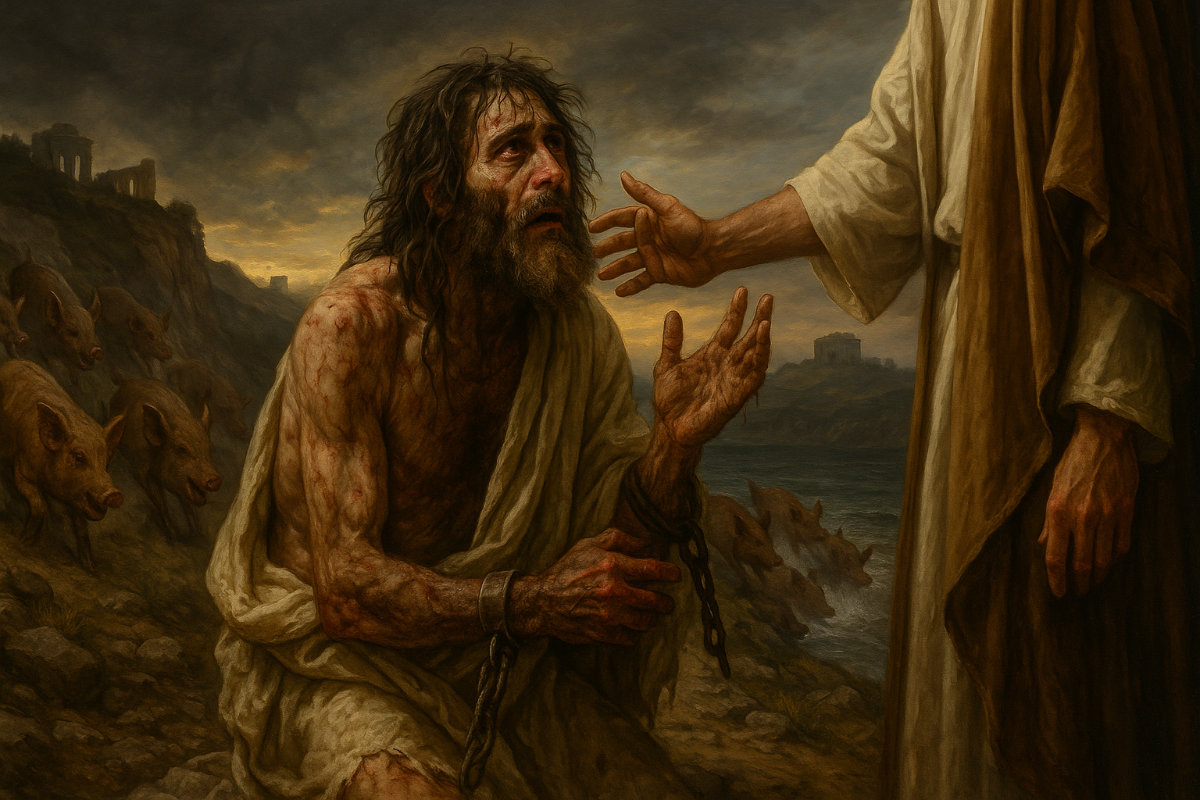
The Gospel accounts place one of Jesus’s most dramatic exorcisms in “the country of the Gadarenes” or “Gerasenes,” depending on the manuscript tradition. Whether this miracle occurred near Gadara or in the territory of Gerasa itself, the story reflects the spiritual landscape of the entire Decapolis region during the 30s AD, when Jesus’s ministry was transforming religious understanding throughout the region.
-> Discover the broader religious context of this period in our “Religious Landscape of Gerasa”
Understanding Demons in the Early Roman World
The inhabitants of early 1st century Gerasa lived in a world where demons (δαιμόνια in Greek) were universally accepted as real spiritual entities. The understanding of these beings drew from centuries of Greek philosophical thought and popular religious practice that had become established in the Hellenized cities of the Decapolis.
In the Greco-Roman tradition that dominated public life in Gerasa, the concept of daimones represented intermediate beings between gods and humans—spirits that could be either beneficial or harmful. This understanding traced back to Plato’s teachings about spiritual beings who served as intermediaries between the divine and mortal realms.
However, by the early Roman period, popular understanding increasingly viewed demons as primarily malevolent forces. They were believed to cause illness, madness, and misfortune. The growing influence of magical practices from Egypt and Mesopotamia had introduced more elaborate systems for dealing with hostile spiritual entities.
Archaeological evidence from the sanctuary of Zeus at Gerasa, particularly the inscribed clef de voûte honoring Demetrios as a “sacred person” (hieroprepés), suggests the continued importance of sacred protection against spiritual threats. The elaborate construction techniques employed by the architect Diodoros in the late 20s AD, including suspended keystone blocks, may reflect not only engineering innovation but also spiritual symbolism—architectural features designed to invoke divine protection over sacred spaces.
Jewish Perspectives on Demonic Forces
The substantial Jewish community in Gerasa brought their own rich tradition of demonology to the city’s spiritual landscape. Jewish understanding in the early 1st century AD was heavily influenced by Second Temple period texts like 1 Enoch and Jubilees, which described elaborate hierarchies of fallen angels and demons.
In Jewish thought of this period, demons were fallen angels or spirits of the wicked dead who sought to harm the living. They were particularly associated with unclean places—tombs, ruins, and wilderness areas. The desert regions around Gerasa, with their caves and rocky outcroppings, would have been considered prime habitats for demonic entities.
Jewish exorcism practices in the early 1st century combined biblical traditions with contemporary magical techniques. Professional Jewish exorcists used combinations of prayer, ritual actions, and sometimes root medicines to drive out evil spirits. The practice was sufficiently established that Jesus’s own exorcisms were initially understood within this existing framework of Jewish spiritual practice.
The Jewish community would have been particularly sensitive to issues of ritual purity and spiritual contamination. Contact with demons or possessed individuals could render a person ritually unclean, requiring specific purification procedures before normal religious and social life could resume.
-> Learn more about the Jewish community’s practices and beliefs in our “Judaism in Gerasa”
The Gospel Account in Cultural Context
The story of the Gerasene demoniac, as recorded in the Synoptic Gospels, reflects the spiritual understanding and social dynamics of the early 1st century Decapolis. The account describes events that would have occurred during Jesus’s ministry, likely in the early 30s AD.
The detail that the demons identified themselves as “Legion” would have carried particular resonance in the Roman-dominated Decapolis. A Roman legion represented not only military might but also organized, disciplined force. The use of this term suggests demons acting in coordinated fashion rather than as isolated entities—a concept that would have been deeply unsettling to contemporary audiences.
However, the context and aftermath of this miracle suggest a more complex situation than typically understood. The location of these events was within the territorial boundaries of ancient Israel, specifically in the region east of the Sea of Galilee that had been allocated to the tribes of Israel. This area, though Hellenized and part of the Decapolis, remained within the Promised Land.
The pig farmers’ reaction to the destruction of their herd provides crucial insight into their identity. Rather than responding with the violent anger that would be expected from Gentile property owners suffering massive economic loss, the people “were afraid and asked Jesus to leave their region.” This fearful, restrained response suggests recognition of divine judgment rather than mere economic outrage.
The presence of Jewish pig farmers in this region would represent a flagrant violation of God’s dietary laws, which explicitly forbade not only eating pork but even touching pig carcasses (Leviticus 11:7-8). For observant Jews witnessing Jesus’s action, the destruction of the unclean animals would have been understood as righteous judgment against those who were defying God’s eternal commandments.
The demons’ request to be sent into the pigs rather than banished from the region may have served a dual purpose: providing immediate relief for the possessed man while simultaneously executing divine judgment on those who had chosen to profit from raising forbidden animals in the Holy Land.
Traditional Approaches to Possession and Healing
In the early 1st century, approaches to what we might now call mental illness or psychological disturbance were understood almost exclusively in spiritual terms. Severe behavioral disorders were typically attributed to demonic possession, divine punishment, or cursing by enemies.
Traditional healing approaches in Gerasa would have included:
Temple Healing: Seeking intervention from gods like Asclepius through temple rituals, offerings, and incubation practices where patients slept in sacred precincts hoping for divine dreams or healing.
Magical Practices: Professional magicians and wonder-workers offered services including exorcism, protective amulets, and binding spells to control hostile spirits.
Jewish Exorcism: Members of the Jewish community could seek help from their own religious specialists who used biblical texts, divine names, and ritual procedures.
Philosophical Therapy: Some educated individuals might seek help from philosophers who offered rational explanations for disturbing thoughts and behaviors.
The revolutionary aspect of Jesus’s approach was its combination of divine authority with compassionate restoration. Unlike traditional exorcisms that often involved elaborate rituals or magical techniques, the Gospel accounts emphasize the immediate effectiveness of Jesus’s simple commands.
The Social Context of Possession
Cases of suspected demonic possession had severe social consequences in early 1st century Gerasa. Possessed individuals were typically excluded from normal community life, unable to participate in religious, economic, or social activities.
The Gospel description of the Gerasene demoniac living among the tombs reflects actual social practice. Severely disturbed individuals were often driven from populated areas and forced to survive in marginal spaces—caves, ruins, or cemetery areas outside city walls. This exile served both to protect the community and to contain what was perceived as spiritual contamination.
The man’s inability to be bound with chains, as described in Mark’s Gospel, reflects both the supernatural strength attributed to demonic possession and the community’s attempts to control dangerous individuals. Iron chains were expensive and represented significant community investment in attempting to manage the situation.
The detail that he cut himself with stones indicates self-destructive behavior that would have been interpreted as evidence of demonic control. Such actions were seen as the demon using the possessed person’s body for its own malevolent purposes.
Revolutionary Aspects of Christian Exorcism
The Christian approach to demonic possession, as demonstrated in the Gospel accounts, represented a significant departure from contemporary practices. Rather than elaborate rituals, magical formulas, or expensive offerings, Christian exorcism relied solely on divine authority exercised through Jesus’s name.
This approach had several revolutionary implications:
Accessibility: Unlike temple healing or professional magical services, which required payment or social status, Christian healing was offered freely to all social classes.
Immediate Effectiveness: While traditional approaches often required extended procedures, Christian exorcisms were typically instantaneous.
Complete Restoration: Rather than simply driving out demons, Christian healing included full restoration to community life, as illustrated by the Gerasene demoniac being found “clothed and in his right mind.”
Divine Authority: Christian exorcism claimed direct divine backing rather than relying on intermediate spiritual techniques or negotiations with demonic forces.
The Economic and Social Impact
The Gospel account’s conclusion—the destruction of the pig herd and the community’s request for Jesus to leave—illuminates the complex relationship between spiritual power and economic interests in early 1st century society.
The pig owners’ economic loss would have affected not only them but the broader economic network that depended on livestock trade. Herders, traders, and meat sellers would all have suffered from the sudden destruction of valuable animals.
The community’s ambivalent response—acknowledging the miracle while requesting Jesus’s departure—reflects the tension between recognizing divine power and protecting established economic and social systems. This reaction was probably typical of how revolutionary religious movements were received in cosmopolitan Decapolis cities.
Conclusion
The spiritual landscape of early 1st century Gerasa was characterized by diverse but universally held beliefs about supernatural forces and their impact on human life. Demons were understood as real entities capable of causing severe physical, mental, and social disruption. Multiple healing traditions offered various approaches to dealing with these spiritual threats.
Into this context came the Christian message with its claims of absolute authority over demonic forces. The story of the Gerasene demoniac illustrates both the power and the problems associated with this new approach. While the healing itself was undeniably effective, its economic and social consequences created tension between spiritual liberation and community stability.
For the inhabitants of Gerasa in the 30s AD, the events described in the Gospels would have represented an encounter with unprecedented spiritual authority. Whether they embraced or rejected this new teaching, they could not ignore its implications for understanding the relationship between divine power, demonic forces, and human suffering in their cosmopolitan but deeply religious world.
Disclaimer:
All images used in this article are the property of their respective owners. I do not claim ownership of any images and provide proper attribution and links to the original sources when applicable. If you are the owner of an image, please contact us so I can add your information or remove it if you wish.
Sources:
- “Official Guide to Jerash” with plan by Gerald Lankester
- “The Chora of Gerasa Jerash” by Achim Lichtenberger and Rubina Raja
- “Jarash Hinterland Survey” by David Kennedy and Fiona Baker
- “Antioch on the Chrysorrhoas Formerly Called Gerasa” by Achim Lichtenberger and Rubina Raja
- “Jarash Hinterland Survey — 2005 and 2008” by David Kennedy and Fiona Baker
- “A new inscribed amulet from Gerasa (Jerash)” by Richard L. Gordon, Achim Lichtenberger and Rubina Raja
- “Apollo and Artemis in the Decapolis” by Asher Ovadiah and Sonia Mucznik
- “Onomastique et présence Romaine à Gerasa” by Pierre-Louis Gatier
- “Dédicaces de statues “porte-flambeaux” (δαιδοῦχοι) à Gerasa (Jerash, Jordanie)” by Sandrine Agusta-Boularot and Jacques Seigne
- “Un exceptionnel document d’architecture à Gérasa (Jérash, Jordanie)” by Pierre-Louis Gatier and Jacques Seigne
- “Zeus in the Decapolis” by Asher Ovadiah and Sonia Mucznik
- “The Great Eastern Baths at Gerasa Jarash” by Thomas Lepaon and Thomas Maria Weber-Karyotakis
- “Architectural Elements Wall Paintings and Mosaics” by Achim Lichtenberger
- “Glass Lamps and Jerash Bowls” by Rubina Raja
- “Water Management in Gerasa and its Hinterland” by David D. Boyer
- “Hellenistic and Roman Gerasa” by Rubina Raja
Leave a Reply