Previous: “Metallurgy and Blacksmithing in Ancient Gerasa”
Note: This article presents a comprehensive view of animal husbandry practices in Gerasa by drawing from archaeological and historical evidence spanning the 1st-2nd centuries AD, creating a complete picture of this vital aspect of daily life.
In the fertile valleys surrounding ancient Gerasa, the lowing of cattle, bleating of sheep, and grunting of pigs formed the soundtrack of agricultural life. Animal husbandry was not merely an economic necessity but a complex system that shaped social relationships, religious practices, and cultural identity in this prominent Decapolis city.
The Geographic Foundation of Animal Husbandry
The region around Gerasa provided ideal conditions for animal husbandry. The city’s position in the fertile hill country of northwestern Jordan, watered by the Chrysorrhoas River (modern Wadi Jerash), created an agricultural paradise. The river valley, known in antiquity as the “stream of gold,” supported extensive terraced farming and provided abundant water for livestock.
The upper wadi between Gerasa and the village of Suf was particularly fertile and rich in water and soils. Archaeological evidence shows this area was managed through terraces, creating optimal conditions for grazing animals. The association of “gardeners of the upper valley” mentioned in inscriptions from the northern theater demonstrates the organized agricultural management of this prime territory.
Modern terraces in Wadi Suf reveal the continuation of ancient farming practices, with the landscape still supporting mixed agriculture and animal husbandry. The natural springs at Suf, approximately 6 km northwest of Gerasa, provided a reliable water source that would have been essential for maintaining large herds of livestock.
-> Discover how water shaped every aspect of life in our Infrastructure and Public Services article
Livestock in the Roman World
Animal husbandry in Gerasa operated within the broader Mediterranean system documented by Roman agricultural writers. Lucius Junius Moderatus Columella, writing in the 1st century AD, provides extensive detail on livestock management in his De Re Rustica (On Agriculture). In Book 7, Columella describes how sheep and goats formed the backbone of most pastoral operations, providing wool, milk, cheese, and meat. He notes these hardy animals were particularly suited to regions with limited rainfall.
Marcus Terentius Varro, in his earlier work Rerum Rusticarum (On Agriculture, Book 2), documents cattle as valuable for their strength in agricultural work, their milk, and their meat. Varro emphasizes that cattle required better pasture and more water than sheep and goats, making them indicators of agricultural prosperity.
Pliny the Elder, in his Naturalis Historia (Natural History, Book 8), provides detailed observations on animal behavior and management practices used throughout the Roman Empire, offering insights into the standardized approaches to livestock care that would have been employed in provincial cities like Gerasa.
Archaeological evidence from the Danish-German Jerash Northwest Quarter Project reveals animal bones that provide direct evidence of the types of livestock consumed in the city, demonstrating consumption patterns consistent with other Roman provincial cities.
The Cultural Significance of Pigs
Pigs occupied a unique position in the cultural landscape of 1st-2nd century Gerasa, reflecting the complex religious and ethnic composition of this Decapolis city. The cultural significance of pigs was dramatically different for various communities within the Roman Empire.
Columella devotes considerable attention to pig husbandry in De Re Rustica (Book 7), describing pigs as efficient converters of kitchen scraps and agricultural waste into valuable meat. He notes that pigs could be kept in relatively small spaces and required less specialized care than cattle, making them ideal for urban and semi-urban environments throughout the Roman world.
For Jewish communities, however, pigs represented forbidden animals under dietary laws. The discovery of a Jewish purity vessel fragment in the Northwest Quarter excavations, dating to before 70 AD, confirms the presence of observant Jews in Gerasa who maintained kashrut (dietary laws) as documented in biblical and rabbinic sources.
Josephus, in his Jewish Antiquities and Jewish War, describes the tensions that arose in mixed populations where Jews lived alongside Gentiles who raised and consumed pork. This religious divide created documented social and economic dynamics throughout the eastern Mediterranean, where Jewish communities avoided pig farming while Gentile farmers could profit from raising pigs for non-Jewish populations.
The presence of significant pig herds in the broader Decapolis region is documented in the Gospel accounts (Matthew 8:28-34, Mark 5:1-20, Luke 8:26-39), which describe a large herd of about 2,000 pigs in the region, indicating substantial Gentile settlement and commercial pig farming operations.
-> Explore the religious complexities of daily life in our Religious Landscape of Gerasa article
Documented Pig Farming Practices
Roman agricultural writers provide detailed documentation of pig farming techniques employed throughout the empire’s provinces. Columella, in De Re Rustica (Book 7, chapters 9-10), describes how pigs were typically kept in sties near human habitation, where they could be fed kitchen scraps, agricultural waste, and foraged materials. He provides specific architectural details for pig housing, including drainage systems and ventilation requirements.
Varro, in Rerum Rusticarum (Book 2, chapter 4), offers practical guidance on pig feeding, noting that acorns from oak forests provided excellent nutrition. This detail is particularly relevant to the Gerasa region, as Theophrastus documents in his Enquiry into Plants that oak forests were common throughout the eastern Mediterranean highlands.
Columella also documents (De Re Rustica, Book 7) the processing of pork into preserved forms like bacon and ham, which was crucial for extending meat’s usefulness beyond immediate consumption. He describes specific salt-curing techniques that allowed pork products to be stored for extended periods and transported over long distances.
Pliny the Elder (Naturalis Historia, Book 8) notes that Mediterranean climates were well-suited to pig farming, with moderate winters allowing outdoor keeping and adequate shade and water access managing summer heat stress.
Economic Integration and Trade
The economic aspects of animal husbandry are documented in various Roman sources. Columella (De Re Rustica, Book 6) describes how animal products were integrated into urban economies, with markets providing venues for livestock sales and workshops processing animal products into finished goods.
Varro (Rerum Rusticarum, Book 2) documents the economic hierarchy of animal ownership, describing how large landowners maintained extensive herds on rural estates using employed labor, while smaller farmers kept fewer animals for subsistence and modest market sales.
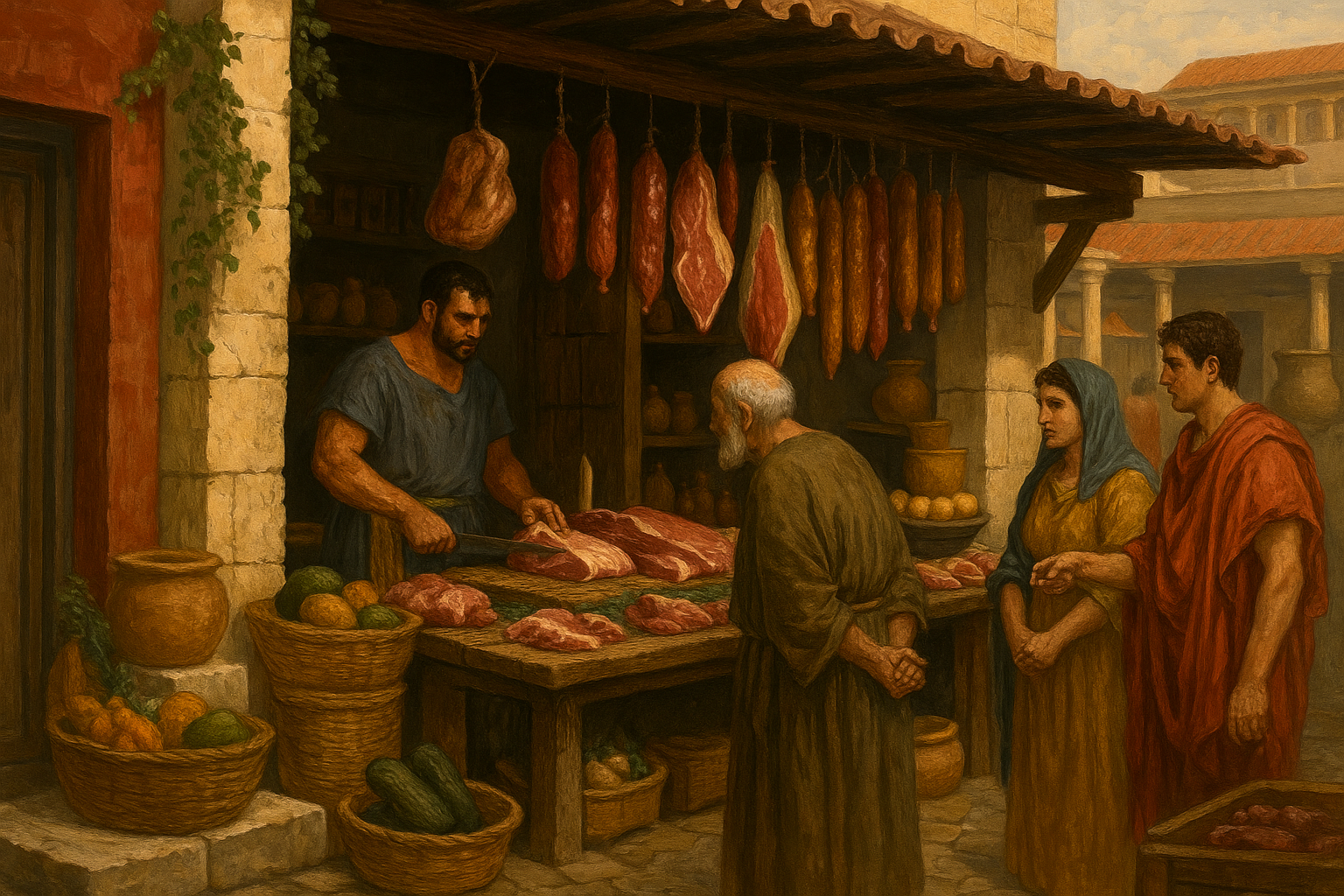
The preservation and trade of meat products is documented by Columella, who describes how the transformation of perishable pork into durable food products like salted ham represented significant added value and enabled participation in long-distance trade networks.
-> Learn about commercial connections in our Economic Life in Gerasa article
Urban Animal Management
The integration of animals into urban life required careful management, as documented in Roman sources. Vitruvius, in De Architectura (Book 6), describes how Roman urban planning accommodated livestock within city limits, particularly smaller animals like pigs, goats, and chickens.
Columella (De Re Rustica, Book 1) addresses the management of animal waste, noting how manure was valuable as fertilizer but required proper handling to prevent health problems. Roman cities developed sophisticated systems for managing these challenges.
Archaeological evidence from well-preserved Roman cities like Pompeii demonstrates how urban households maintained areas for keeping animals, with wealthy households having dedicated stables and pens within their compounds, while lower-status residents used communal areas.
Veterinary Knowledge and Animal Health
Roman agricultural writers documented sophisticated understanding of animal health and disease management. Columella devotes significant attention to veterinary medicine in De Re Rustica (Book 7), describing various animal diseases and their treatments.
Vegetius, in his Mulomedicina (Veterinary Medicine), provides detailed documentation of animal diseases including what we now recognize as anthrax and foot-and-mouth disease, along with various parasitic infections that affected livestock throughout the Roman world.
These sources describe treatments that relied on herbal remedies and dietary management. Pliny the Elder (Naturalis Historia, Books 20-32) documents numerous plant-based remedies used for treating sick animals, some of which showed genuine medical efficacy.
Social Status and Animal Ownership
Roman sources consistently document how animal ownership reflected social hierarchies. Columella (De Re Rustica, Book 1) describes how large landowners maintained extensive herds on rural estates, employing specialized workers including shepherds and herdsmen to manage their livestock.
Varro (Rerum Rusticarum, Book 2) notes how smaller farmers typically owned fewer animals that provided subsistence needs and modest surplus for market sale, while urban residents might keep a pig or goats to supplement their income.
Pliny the Elder (Naturalis Historia, Book 8) documents how ownership of specific animals carried social implications throughout the Roman world, with horses and mules being expensive and primarily owned by the wealthy, while cattle ownership indicated agricultural prosperity and stability.
Religious and Ritual Dimensions
Animals played crucial roles in religious life throughout Gerasa. Roman sources document how temples required regular animal sacrifices, creating demand for ceremonially appropriate livestock. Different deities preferred different animals, with specific requirements for the physical condition and preparation of sacrificial animals.
The conflict between Jewish dietary laws and Greco-Roman religious practices created complex social dynamics documented by Josephus and other contemporary sources. Jewish residents could not participate in most public religious celebrations that involved consumption of non-kosher animals, particularly pork, influencing social relationships and economic partnerships.
-> Discover more about religious practices in our Judaism in Gerasa article
The Biblical Context
The Gospel accounts provide valuable documentation of large-scale pig farming in the broader Decapolis region. Mark 5:13 specifically mentions approximately 2,000 pigs, indicating substantial commercial operations rather than subsistence farming. This number suggests significant investment and infrastructure dedicated to pig farming in the region.
The economic loss represented by the destruction of such a herd would have been catastrophic for the owners, indicating the substantial financial stakes involved in large-scale animal husbandry during this period.
Conclusion
Animal husbandry in ancient Gerasa was a sophisticated system documented through both archaeological evidence and Roman agricultural literature. From Columella’s detailed farming instructions to the archaeological animal bones found in the Northwest Quarter, the evidence reveals how livestock management shaped economic, social, and religious life in this thriving Decapolis city.
The integration of Roman agricultural techniques with local geographic conditions, combined with the complex religious and cultural dynamics of a mixed population, created a unique environment where animal husbandry served as both economic foundation and cultural identifier. For the residents of 1st-2nd century Gerasa, the management of livestock represented not just practical necessity but participation in the broader Roman world while maintaining distinct local and religious identities.
Primary Sources Referenced:
- Columella, De Re Rustica (On Agriculture) – comprehensive Roman agricultural manual
- Varro, Rerum Rusticarum (On Agriculture) – earlier Roman farming treatise
- Pliny the Elder, Naturalis Historia (Natural History) – encyclopedic work including animal management
- Vitruvius, De Architectura (On Architecture) – Roman architectural and urban planning
- Vegetius, Mulomedicina (Veterinary Medicine) – Roman veterinary manual
- Josephus, Jewish Antiquities and Jewish War – contemporary accounts of Jewish-Gentile relations
- Theophrastus, Enquiry into Plants – botanical knowledge relevant to animal feeding
- Gospel accounts (Matthew 8, Mark 5, Luke 8) – biblical documentation of regional pig farming
Disclaimer:
All images used in this article are the property of their respective owners. I do not claim ownership of any images and provide proper attribution and links to the original sources when applicable. If you are the owner of an image, please contact us so I can add your information or remove it if you wish.
Sources:
- “Official Guide to Jerash” with plan by Gerald Lankester
- “The Chora of Gerasa Jerash” by Achim Lichtenberger and Rubina Raja
- “Jarash Hinterland Survey” by David Kennedy and Fiona Baker
- “Antioch on the Chrysorrhoas Formerly Called Gerasa” by Achim Lichtenberger and Rubina Raja
- “Jarash Hinterland Survey — 2005 and 2008” by David Kennedy and Fiona Baker
- “A new inscribed amulet from Gerasa (Jerash)” by Richard L. Gordon, Achim Lichtenberger and Rubina Raja
- “Apollo and Artemis in the Decapolis” by Asher Ovadiah and Sonia Mucznik
- “Onomastique et présence Romaine à Gerasa” by Pierre-Louis Gatier
- “Dédicaces de statues “porte-flambeaux” (δαιδοῦχοι) à Gerasa (Jerash, Jordanie)” by Sandrine Agusta-Boularot and Jacques Seigne
- “Un exceptionnel document d’architecture à Gérasa (Jérash, Jordanie)” by Pierre-Louis Gatier and Jacques Seigne
- “Zeus in the Decapolis” by Asher Ovadiah and Sonia Mucznik
- “The Great Eastern Baths at Gerasa Jarash” by Thomas Lepaon and Thomas Maria Weber-Karyotakis
- “Architectural Elements Wall Paintings and Mosaics” by Achim Lichtenberger
- “Glass Lamps and Jerash Bowls” by Rubina Raja
- “Water Management in Gerasa and its Hinterland” by David D. Boyer
- “Hellenistic and Roman Gerasa” by Rubina Raja
Leave a Reply